L’Olympia still measures what certification cannot
The venues still form a ladder, and how fast you climb it tells the whole story.
The Rooms in Order
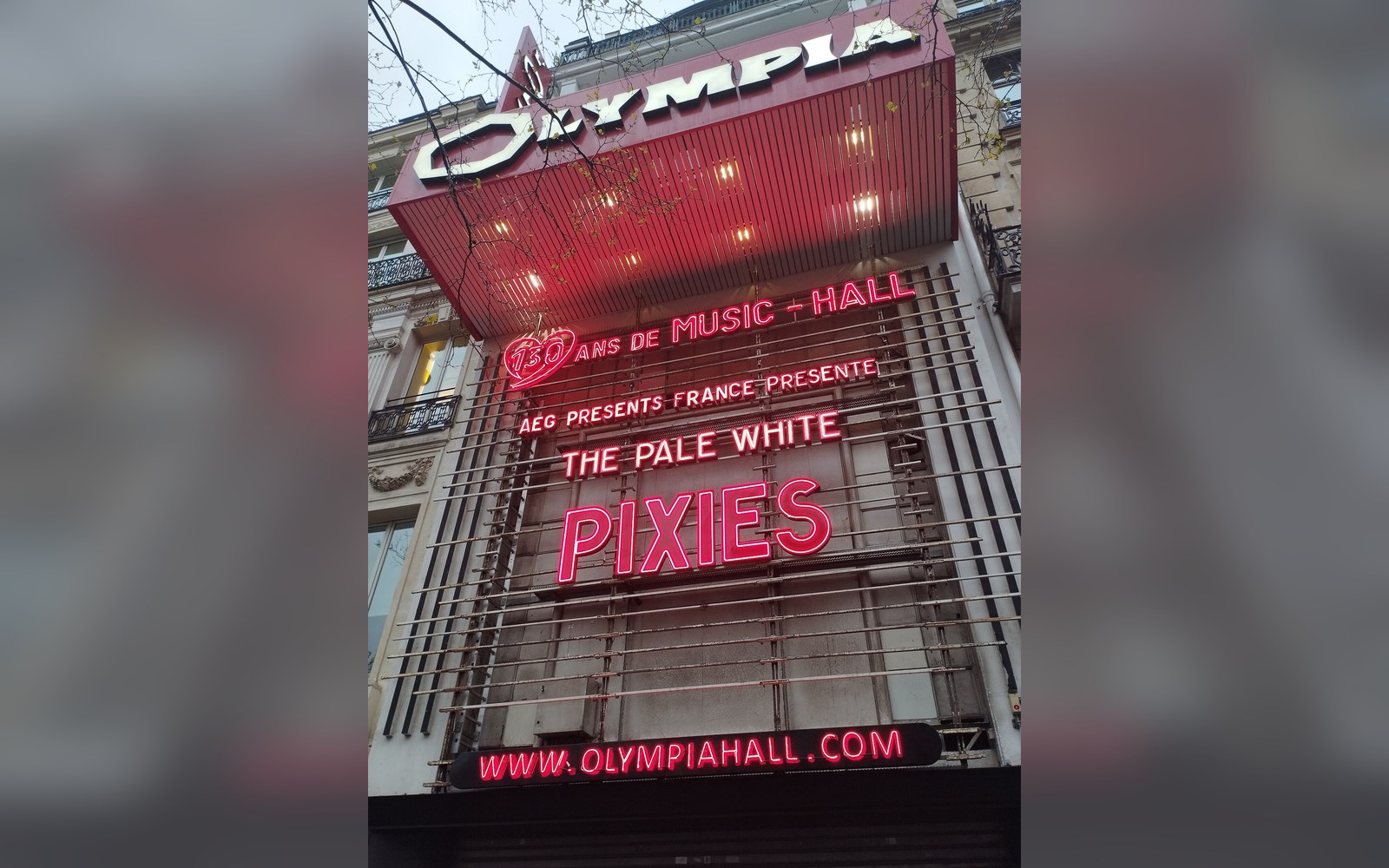
Paris has a small number of venues that every working musician in French music understands as a sequence. La Cigale holds around 1,400; Le Trianon, slightly smaller, roughly 1,000. L'Olympia sits at around 2,000, but its weight is historical rather than merely numerical: opened in 1893 on the Boulevard des Capucines, it is the room where Édith Piaf, Jacques Brel and Barbara gave their defining performances, and where the mythology of French chanson — song as a serious literary act, the voice against a room — was made physical. Above all of them sits the Accor Arena in Bercy, a 20,000-seat hall in the 12th arrondissement that functions less as a venue than as a reckoning: you play Bercy when the question of your scale has already been answered.
A career in French music is still legible, in 2025, as a sequence of these rooms, each one roughly four times the last. La Cigale or Le Trianon announce that an artist has an audience. L'Olympia confirms they have a career. The Accor Arena says something different: that streaming numbers have translated into bodies in a specific building, on a specific night, at prices that work at scale.

What the Ladder Measures
The sequence matters because it is one of the few metrics that the industry has not been able to rewire. Certification, as Ninho and Damso's records demonstrate, now measures streams rather than physical units, which makes it a count of attention across time rather than a single committed act. A sell-out at L'Olympia is still an unambiguous number: every seat either has a person in it or it does not.
That is why the Victoires de la Musique, the industry's annual prize-giving, and the venue ladder operate as parallel systems rather than the same system. The Victoires reward a committee's reading of the year. The rooms reward an audience's willingness to pay and travel. They do not always agree. Artists who sweep the Victoires can sell modestly at the box office; artists who fill Bercy repeatedly may go unrewarded by the industry for years.
Aya Nakamura, the most-streamed French-language artist in the world, has sold out major rooms across Europe without the Victoires consistently reflecting that reach. Stromae's return with Multitude in 2022 included a run of dates that demonstrated, room by room, that his audience had waited and grown. Bigflo & Oli, from Toulouse, made the transition to large-format venues while remaining a story about a city rather than an institution. Each of these is a different version of the same legibility: where you play tells people where you are.

Beyond the Capital
The ladder is Parisian in its architecture but not exclusive in its geography. Rock en Seine, held annually in the southwest of Paris, and Les Vieilles Charrues in Brittany operate outside the venue sequence entirely — festivals with capacities that dwarf Bercy, where the booking is curatorial rather than a milestone. Marseille has its own infrastructure, and Jul's hold on that city's venues has been sustained over years without requiring Parisian validation at every step.
What the Paris ladder gives that festivals and regional venues cannot is narrative compression. Because L'Olympia and Bercy are fixed, permanent and storied, the gap between them is always the same distance. An artist who crosses it in two years is moving fast; one who takes eight has a different kind of story. The room does not change. The calendar around it does. That gap — legible, shared, agreed upon by the industry and by anyone who buys a ticket — is what makes the sequence still function as a map of a career, thirty years after the Loi Toubon reshaped the radio and streaming reshaped everything else.